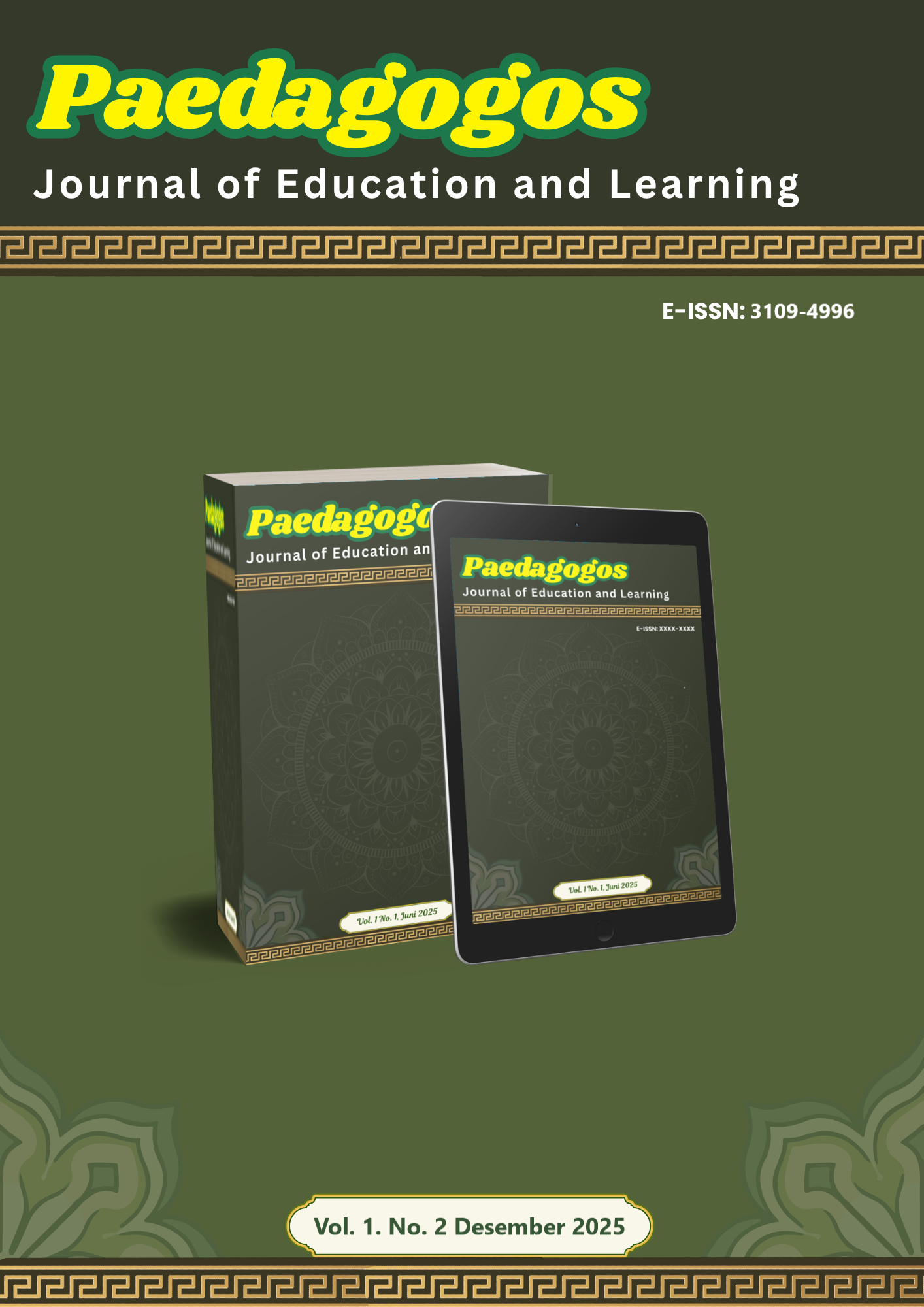
Desain dan Pengembangan Kurikulum Pendidikan Menengah: Kajian Teoritis dan Konseptual di Era Digital
DOI:
https://doi.org/10.64131/paedagogos.v1i2.32Keywords:
Curriculum Design, Development, Curriculum, DigitalizationAbstract
The curriculum plays a central role in determining the quality of education; however, the dynamics of policy changes and technological developments in the digital era demand a more adaptive and contextual design. This study aims to analyze the theoretical foundations of curriculum development, examine relevant conceptual models, and evaluate the curriculum's response to 21st-century needs. The research method employed is library research with a descriptive-qualitative approach through thematic analysis of academic literature and national policy documents. The results indicate that an ideal curriculum development must be grounded in the principles of relevance, flexibility, continuity, and integration, while adopting philosophical approaches such as constructivism and reconstructionism. The discussion highlights that technological integration is an inevitability, although its implementation is still hindered by infrastructure gaps and low digital literacy. It is concluded that future curriculum development requires a responsive conceptual design to not only transfer knowledge but also equip students with adaptive life skills and digital ethics.
Downloads
Downloads
Published
Issue
Section
License
Copyright (c) 2025 Hairul Marif, Muhammad Burhanudin Al Mu'allif, Ahmad Nafis, Sukron Makmun, Nur Ahid (Author)

This work is licensed under a Creative Commons Attribution-ShareAlike 4.0 International License.