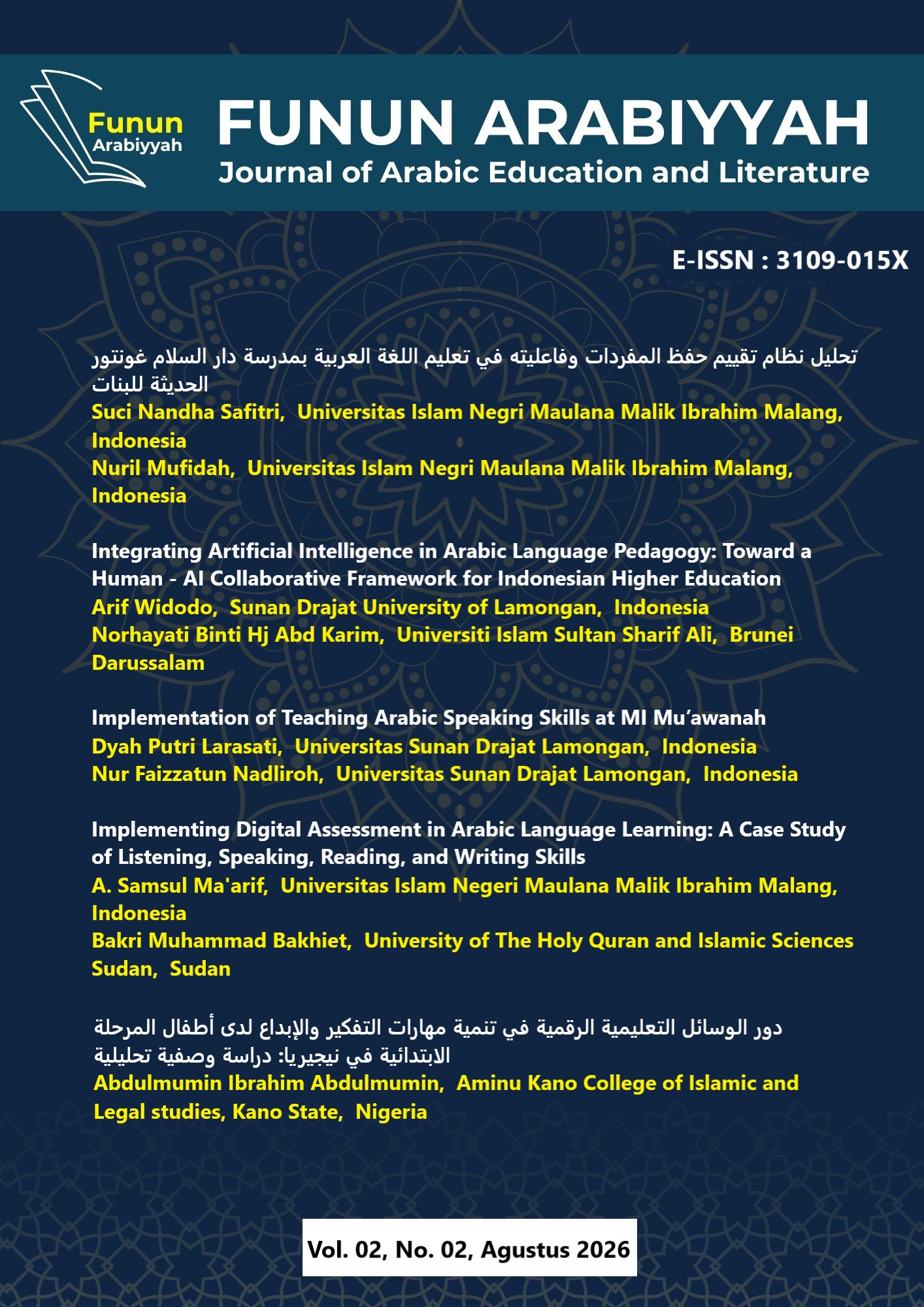
Implementing Digital Assessment in Arabic Language Learning: A Case Study of Listening, Speaking, Reading, and Writing Skills
DOI:
https://doi.org/10.64131/fununarabiyyah.v2i2.146Keywords:
Arabic language skills, digital assessment, digital technology, istimā‘ kalām kitābah and qirā’ahAbstract
The transformation of education through digital technology has reshaped language assessment practices, including the assessment of Arabic language learning. Digital assessment offers new possibilities for conducting language evaluation in ways that are more flexible, interactive, authentic, and responsive to learners’ performance. However, its implementation in Arabic language assessment remains complex because the four language skills—istimā‘ (listening), kalām (speaking), qirā’ah (reading), and kitābah (writing)—require different assessment formats, technological affordances, and criteria of performance. This study examines how digital assessment is implemented to assess the four Arabic language skills and identifies the pedagogical and technical challenges that emerge during its implementation. A qualitative case study design was employed to investigate assessment practices, lecturer experiences, student responses, and the use of digital assessment instruments in an Arabic language learning context. Data were collected through semi-structured interviews, classroom observations, and document analysis, and were analyzed thematically to identify patterns across the four language skills. The findings indicate that digital assessment facilitates more flexible task administration, rapid feedback, multimedia-based assessment, and greater opportunities to document students’ language performance. Nevertheless, its implementation varies across skills: listening and reading are relatively adaptable to digitally mediated tasks, whereas speaking and writing require more careful consideration of interaction, authenticity, scoring procedures, and technological constraints. The study also identifies challenges related to instrument design, assessment consistency, digital literacy, technological infrastructure, and the alignment between assessment tasks and the specific characteristics of each skill. The study contributes a context-sensitive understanding of digital assessment in Arabic language education by showing that technological adoption alone does not guarantee meaningful assessment; its pedagogical value depends on the alignment among digital tools, language-skill characteristics, assessment principles, and learning objectives.
Downloads
References
Alavi, Sayyed Mohammad, Dashtestani, Reza, & Mellati, Morteza. (2022). Crisis and changes in learning behaviours: Technology-enhanced assessment in language learning contexts. Journal of Further and Higher Education, 46(4), 461–474. https://doi.org/10.1080/0309877X.2021.1985977
Creswell, John W., & Poth, Cheryl N. (2018). Qualitative inquiry and research design: Choosing among five approaches (4th ed.). SAGE Publications.
Fuller, Richard, Goddard, Viktoria C. T., Nadarajah, Vishna D., Treasure-Jones, Tamsin, Yeates, Peter, Scott, Karen, Webb, Alexandra, Valter, Krisztina, & Pyörälä, Eeva. (2022). Technology enhanced assessment: Ottawa consensus statement and recommendations. Medical Teacher, 44(8), 836–850. https://doi.org/10.1080/0142159X.2022.2083489
Grab, Melissa Özlem. (2025). Assessing language proficiency in the digital age: Exploring innovative methods for assessment and feedback in ESL classrooms. Journal of Digital Educational Technology, 5(2), ep2510. https://doi.org/10.30935/jdet/16286
Jurāne-Brēmane, Anžela. (2023). Digital assessment in technology-enriched education: Thematic review. Education Sciences, 13(5), 522. https://doi.org/10.3390/educsci13050522
Kamal, Ahlal. (2026). Digital assessment tools in Arabic language learning: Test and non-test based technology. Al-Badi’ Journal: Journal of Arabic Language Education and Arabic Language Studies, 1(1).
Lincoln, Yvonna S., & Guba, Egon G. (1985). Naturalistic inquiry. SAGE Publications.
Ma'arif, A. Samsul, & Rosikh, Fahrur. (2025). Integrating Arabic language learning and Islamic religious education for religious character formation. Ummul Qura: Jurnal Institut Pesantren Sunan Drajat (INSUD) Lamongan, 9(2), 256–262. https://doi.org/10.55352/uq.v9i2.2258
Ma'arif, A. Samsul, Sa'diyah, Halimatus, & Bakhiet, Bakri Muhammad. (2026). Learning Arabic with ease, skill, and joy: A pedagogical model from PKPBA UIN Maliki Malang. FASHOHAH: Jurnal Ilmiah Pendidikan Bahasa Arab, 6(1), 22–34. https://doi.org/10.33474/fsh.v6i1.24793
Miles, Matthew B., Huberman, A. Michael, & Saldaña, Johnny. (2014). Qualitative data analysis: A methods sourcebook (3rd ed.). SAGE Publications.
Rahman, Nur Fuadi, Masdar, Muhammad Ihsanuddin, Ilmiani, Aulia Mustika, Habibie, Faizal, & Samdouni, Soukaina. (2022). Transformation of Arabic assessment in Indonesia: Conventional assessment toward digital assessment. Al-Ta'rib: Jurnal Ilmiah Program Studi Pendidikan Bahasa Arab, 10(2), 199–212. https://doi.org/10.23971/altarib.v10i2.4510
Yin, Robert K. (2018). Case study research and applications: Design and methods (6th ed.). SAGE Publications.
Downloads
Published
Issue
Section
License
Copyright (c) 2026 A. Samsul Ma'arif, Bakri Muhammad Bakhiet (Author)

This work is licensed under a Creative Commons Attribution-ShareAlike 4.0 International License.