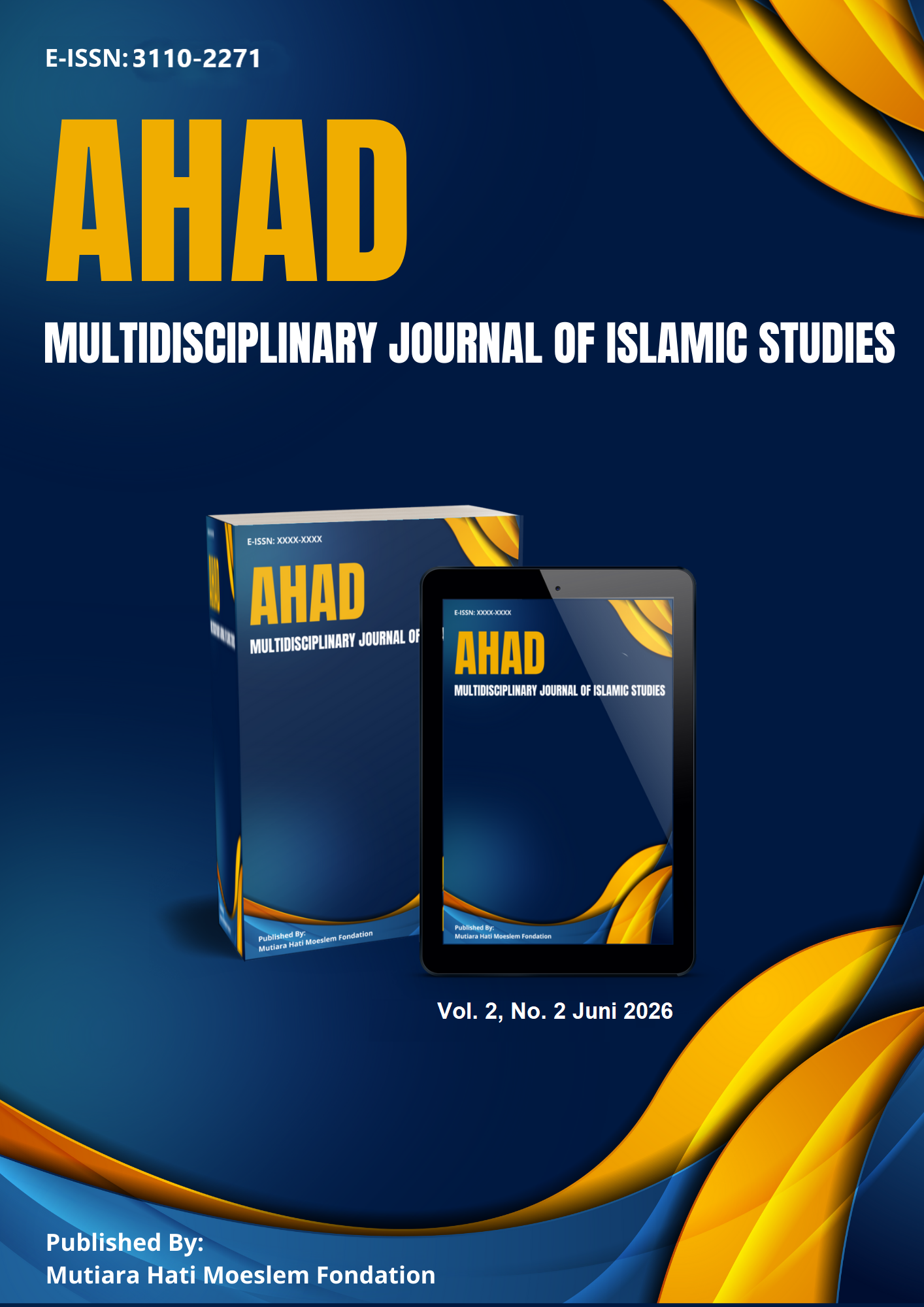
Challenges and Strategies for Enhancing Islamic Education through the Hausa Language in Niger State Nigeria
DOI:
https://doi.org/10.64131/ahad.v2i2.119Keywords:
Hausa Language, Islamic Education, Challenges, StrategiesAbstract
This study examined the challenges and strategies for enhancing Islamic education through the Hausa language in Niger State, Nigeria. A descriptive survey design was employed involving 196 teachers selected from Islamic schools within the Kontagora Emirate Council. Data were collected using a structured questionnaire and analyzed using mean and standard deviation. The findings revealed that the major challenges affecting the use of Hausa language in Islamic education include the lack of standardized Hausa Islamic textbooks across schools and the poor translation of Islamic materials from Arabic into Hausa, which often leads to distortion of meaning. The study further found that the provision of digital Hausa Islamic resources, such as audio materials, videos, and mobile applications, as well as the development of standardized Hausa-language textbooks, are key strategies for improving Islamic education. The study concludes that strengthening Hausa-language educational resources and promoting standardized instructional materials can significantly enhance the effectiveness of Islamic education in Niger State. It is therefore recommended that government agencies and religious organizations collaborate to support the development and dissemination of quality Hausa-language Islamic educational materials.
References
Abdullahi, A. Y; Achara, I. Z; & Usman, M. (2023). Arabic as an international language for renaissance: Impact on the Muslim Ummah. Arabic Language, Literature & Culture, 8 (1), 1-8. doi: 10.11648/j.allc.20230801.11
Abdulmumin, S. A. (2024). Hausa language communication and development. A Paper Presented At 1st International Conference Organized by Department of Mass Communication Ahmadu Bello University, Zaria, Nigeria on the Theme: Communication, Media, Insecurity, And Development: Issues, Challenges and Way Forward.
Abubakar, H. A (2024). Effect of utilization of native language (Hausa) in teaching integrated science among private primary schools pupils: A case study of Gwadabawa Local Government Area, Sokoto State, Nigeria. Nautical: Jurnal Ilmiah Multidisiplin, 3 (3), 1 - 6. Retrieved from https://jurnal.arkainstitute.co.id/index.php/nautical/index
Ahmad U. (2025). Integrating hausa language and culture into the basic education curriculum in northern Nigeria: implications for cultural preservation and literacy development. International Journal of Research Publication and Reviews, 6 (8), 1994-1998
Ainu, H. A. (2018). Hausa language writing as a vehicle for development of islamic literature. International Journal of Humanities and Social Science Invention (IJHSSI) 7 (7), 27-31
Akachukwu, O. M; & Muomalu, U. C. (2023). The contributions of language to the cultural heritage of the hausa society. International Journal of Research and Scientific Innovation (IJRSI), 10 (4), 122 - 129. https://doi.org/10.51244/IJRSI.2023.10416
Alhasan, K; Sani, B; Shehu, S; Usman, F; & Miya, Y. Y. (2025). Using Hausa language in the assessment of students: A case study of higher institution in Bauchi, Nigeria. Kashf Journal of Multidisciplinary Research, 2 (6), 7-12.
Audia, R. I; & Agil, P. (2024). Responsibilities of islamic education institutions. Jurnal Pendidikan Islam, 1 (3), 159-171
Catoh, C; & Bivan, D. A. (2019). An assessment of the implementation of mother tongue on the language of the immediate community at the pre-primary education level in the northwestern Nigeria. International Journal of Education and Social Science Research, 2(5), 9-20.
Dagimun, M. U. (2018). Interaction between Islam and Hausa culture after sokoto caliphate in Nigeria and the role of colonialists. Ar-Raniry, International Journal of Islamic Studies, 5 (2), 189-196
El-Mubarak, A. M. O. I; & Hassan, I. (2021). Challenges of Islamic Education in the Era of Globalization: A Proposed Holistic Solution. International Journal of Academic Research in Progressive Education and Development, 10(3), 337–349.
Garba, S. K; & Umar, Y. (2025). Problems of Integration of Traditional Islamic Education Schools with the Western Education School System in Yobe State. UKR Journal of Arts, Humanities and Social Sciences (UKRJAHSS), 1(10), 64-71
Hidayah, N; Samsiadi, Siscawati, M; Yazid, S; & Haris, A. (2022). Islamic Education Problems and their Solutions (Quality Of PAI Teachers). Research and Development Journal of Education, 8(2), 598-606. DOI: http://dx.doi.org/10.30998/rdje.v8i2.13441
Mahmood, S. K. (2019). Prospects and problems of teaching Islamic Studies: A case study of primary schools in Akre- Kurdistan. International Journal of English, Literature and Social Science (IJELS), 4 (5), 1420 -1430. https://dx.doi.org/10.22161/ijels.45.28
Muhammad, A. L. (2025). The role of Hausa language in eradicating socio-economic challenges in northern Nigeria. Existentia: Concrescence Journal of Arts and Humanities, 3 (1), 68-73. https://journals.casjournals.com/index.php/ECOJAH
Mwendwa, E; & Gori, J. (2019). Relationship between school feeding programme and the pupils’ effectiveness in learning in public primary schools in Kitui County.Scientific Research Journal (SCIRJ), 7(7), 1-24. Available at http://dx.doi.org/10.31364/SCIRJ/v7.i7.2019.P0719667.
Olagunju, K. (2022). The challenge of indigenous language resources in Nigeria’s Education System. International Journal of Language Policy, 18(3), 99-113.
Olotuah, A.O and Olotuah, D.E. 2016. Space and Cultural Development in Hausa Traditional Housing. International Journal of Engineering Sciences and Research Technology, 5, 9, 654-659.
Omikunle, S. A; Yusuf, O. Y; & Rabiu, Z. M. (2025). Impact of Hausa language on English proficiency among secondary school students in Kano state, Nigeria. African Journal of Social and Behavioural Sciences (AJSBS), 15 (3), 1143 - 1165
Research Advisor (2006). Sample size table. Retrieved from http://research-advisors.com.
Wushishi, D. I; Ashafa, A. N; & Sadiq, H. O. (2016). Effects of Hausa language of instruction on secondary school biology students’ academic performance in Sokoto State, Nigeria. IJSRSET 2(3), 551-558
Yahya, A. (2018). Tsangaya: The traditional Islamic education system in Hausaland. Jurnal Pendidikan Islam, 4 (1), 1-14. DOI: 10.15575/jpi.v4i1.2244
Zailani, A. A. (2025). Teaching and learning Hausa language through proverbs. Communications on Applied Nonlinear Analysis, 32 (8), 646 - 653.
Downloads
Published
Issue
Section
License
Copyright (c) 2026 Ishaq Abubakar Dauda, Muhammad Awal Inuwa (Author)

This work is licensed under a Creative Commons Attribution-ShareAlike 4.0 International License.